
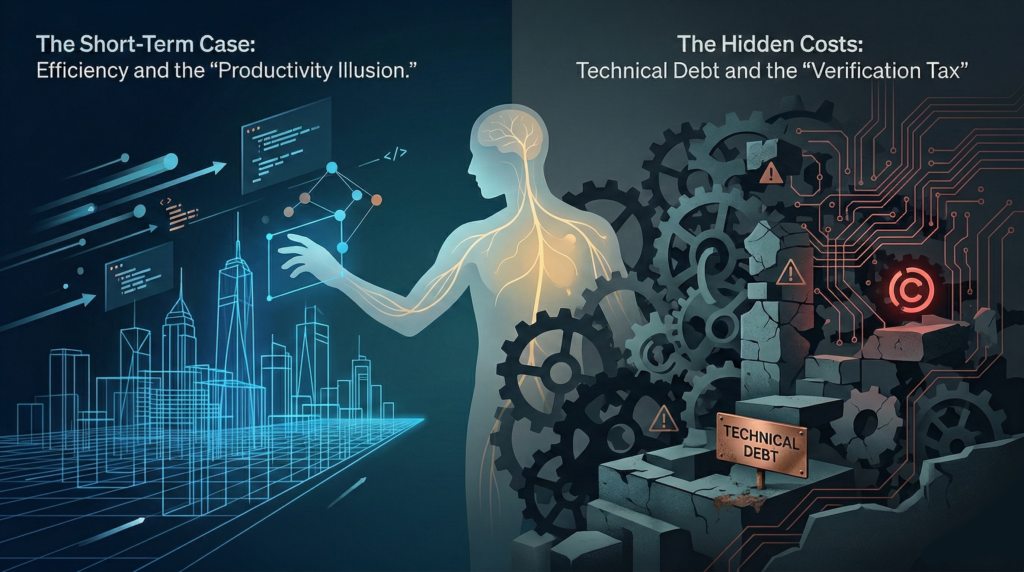
Understanding the 5 Critical AI-Driven Development Risks: The Cost of Cutting is essential for any business considering a reduction in staff in 2026. While many leaders are focused on reducing developer headcount, the long-term impact on IP and talent is significant.
The year 2026 has become the “Year of the Great Re-evaluation” for the software industry. What began as a gold rush to replace expensive human developers with highly efficient AI agents has met the cold reality of long-term operational risk. While the immediate fiscal benefits of reducing developer headcount are undeniable, forward-thinking CTOs are now grappling with a sobering realization: you cannot automate away the need for institutional memory, architectural integrity, and a skilled talent pipeline.
This article examines the complex trade-offs of the AI-powered era, weighing short-term financial gains against the existential AI-driven development risks facing modern enterprises.
Understanding the 5 Critical AI-Driven Development Risks: The Cost of Cutting
1. The Productivity Illusion and Short-Term Gains
The primary driver for reducing developer headcount is, predictably, the bottom line. AI coding assistants have fundamentally changed the cost-per-line of code by automating the “mechanical” aspects of software engineering.
Massive Reduction in “Boilerplate” Costs
In traditional development, a significant portion of a developer’s salary was spent on repetitive tasks: writing unit tests, setting up API endpoints, and translating business logic into syntax. Modern AI now handles roughly 50% of these tasks. For a business, this translates to a 2:1 productivity ratio—theoretically allowing three developers to do the work that previously required six.
Accelerated Time-to-Market
AI doesn’t get “writer’s block.” It can generate a minimum viable product (MVP) in days rather than months. For startups and competitive enterprises, this speed allows for rapid market testing. By leaning on AI and a skeleton crew of senior “orchestrators,” companies can outpace competitors who are still bogged down in manual sprint cycles.
2. The Hidden Liability: Software Intellectual Property (IP) Loss
One of the most overlooked AI-driven development risks is the erosion of a company’s primary asset: its proprietary code. In 2026, the legal landscape is increasingly clear—purely AI-generated code often lacks the “human authorship” required for copyright protection.
The “Public Domain” Trap
By aggressively reducing developer headcount and letting AI write the bulk of the logic, businesses inadvertently create a codebase that is legally difficult to defend.
Copyright Eligibility: In many jurisdictions, including the U.S. and Australia, AI-generated works without “sufficient human authorship” cannot be copyrighted. If a competitor clones your AI-generated features, you may have no legal standing to stop them.
Licensing Contamination: AI often inadvertently “regurgitates” code from restrictive open-source licenses (like GPL). Without enough human developers to audit these snippets, a company risks a Software Intellectual Property (IP) loss that could force them to open-source their entire proprietary stack.
3. Managing AI Technical Debt and Verification Costs
While the speed of generation has increased, the cost of verification has skyrocketed. Recent data suggests that while developers feel faster, they are often measurably slower when tasked with debugging AI-generated code that they didn’t write themselves.
The Rise of “Shadow” Debt
AI technical debt occurs when AI-generated code is syntactically correct but contextually “blind.” It might solve the immediate problem but introduce a bottleneck three layers deep in the architecture.
The Churn Problem: Code churn—the rate at which code is rewritten shortly after being merged—has doubled since 2024.
Security Surge: There has been a marked increase in open-source vulnerabilities per codebase. AI often pulls in outdated libraries or omits critical security checks, such as tenant isolation, leading to hidden debt that stays silent until a breach occurs.
Key Insight: For every hour saved by using AI to write code, teams are spending nearly two hours in rigorous verification and testing to ensure long-term system stability.
4. Breaking the Junior Developer Talent Pipeline
Perhaps the most alarming consequence of focusing solely on reducing developer headcount is the destruction of the talent pipeline. The “Junior Developer” is becoming an endangered species, creating a vacuum that will haunt the industry by 2030.
The Erosion of Institutional Memory
When you replace five developers with one AI-powered senior, you lose the “why” behind the code. AI knows how to write a function, but it doesn’t remember why a specific edge case was handled that way during a high-stakes outage three years ago. If your remaining senior developers leave, the AI cannot explain the architectural intent. The company is left with a “black box” codebase that no one truly understands.
Starving the Future
Historically, senior engineers were forged in the fires of junior-level “drudge work.” By debugging small issues and writing boilerplate, they learned the foundational mechanics of software.
The Problem: If AI does all the junior work, there is no entry point for new talent.
The Consequence: By dismantling the junior developer talent pipeline, we are essentially “eating our seed corn.” We are prioritizing 2026 profit margins at the expense of 2030’s leadership and innovation.
5. The Workforce Crisis and Algorithmic Legacy
As the number of skilled people in the workforce shrinks, the “cost of entry” for new software businesses increases. Companies that fired their mid-level staff in 2024 and 2025 are now finding themselves in a bidding war for the few remaining human architects who can actually fix the mess that autonomous AI agents have created. This “Algorithmic Legacy” is the final of the 5 critical AI-driven development risks: a world where we have plenty of code, but very few people who know how it works.
Strategic Recommendation: The “Human-Centric AI” Model
To survive the next decade, businesses must move away from the “headcount reduction” mindset and toward “capability expansion.”
| Aspect | Headcount Reduction Approach (High Risk) | Capability Expansion Approach (Low Risk) |
|---|---|---|
|
Goal |
Minimize salary expense. |
Maximize product innovation. |
|
Team Structure |
Skeleton crew of seniors + AI. |
Balanced teams using AI as a multiplier. |
|
IP Strategy |
Ignore; focus on speed. |
Rigorous “human-in-the-loop” documentation. |
|
Outcome |
High technical debt; fragile systems. |
Robust, proprietary, and scalable systems. |
Finding the Balance
- Don’t Fire Juniors; Re-skill Them: Instead of cutting entry-level roles, pivot them into “AI Quality Assurance” and “Prompt Architects.” Let them use AI to handle the volume, but require them to document the logic to preserve domain knowledge.
- Audit for “Human Authorship”: Ensure that every critical module has a significant human-written component (at least 20-30%) to maintain copyright and patent eligibility.
- Track “Total Cost of Ownership”: Don’t just look at the salary saved. Measure the increase in QA time, the cost of AI tokens, and the impact of code churn on your release cycles.
Preventing the Collapse of Institutional Memory
Beyond the 5 critical AI-driven development risks, there is the subtle danger of “knowledge siloing.” When a business focuses on reducing developer headcount, they often lose the informal knowledge transfer that happens during peer reviews.
To combat this, companies must implement an AI-Knowledge Audit. This involves:
Logic Tagging: Requiring human developers to tag AI-generated modules with the “business intent” behind them.
Reverse Engineering Drills: Periodically asking senior engineers to explain a system built by AI to ensure they still understand the underlying architecture.
Without these steps, the junior developer talent pipeline isn’t the only thing at risk; the senior leadership’s ability to pivot their own product becomes compromised.
Before finalizing a strategy centered on reducing developer headcount, ask your leadership team these four questions:
IP Defense: Can we prove 25% human authorship in our latest release to secure our Software Intellectual Property (IP) loss protections?
Debt Management: Is our AI technical debt increasing our sprint cycle time by more than 15%?
Talent Pipeline: Do we have a clear path for a junior hire to become a senior architect in an AI-heavy environment?
Operational Resilience: If our AI tool went offline today, does our current headcount have the skill to maintain the legacy code?
Conclusion
Using AI to reduce developer headcount is a siren song: it offers immediate financial relief but often leads to long-term architectural and legal shipwreck. The companies that thrive in the late 2020s will be those that treat AI not as a replacement for people, but as a power tool that allows their people to focus on higher-order system design.
In the world of software, code is cheap, but understanding is priceless. If you lose the people who understand your system, you no longer own a product—you own a liability.
Successfully navigating the 5 Critical AI-Driven Development Risks: The Cost of Cutting will define which companies survive the AI transition.